Badges are one of the most honest things on a Roblox profile, because they are earned over time and stamped with a date. You cannot rush them and you cannot edit the dates. That makes a person's badge history a quiet record of how an account has actually been used, which is exactly what you want when you are trying to read a stranger before you group up, trade, or trust them. The BGC Panel Roblox badge checker reads that history from public data and lays it out so you can take it in at a glance.
What Roblox badges are and where they live
Roblox badges are small achievements awarded inside experiences. Some are handed out the first time you join a game, others for hitting a milestone, finishing a level, or playing on a special day. They are not the old player badges Roblox retired, and they are not gamepasses you can pay for. Each one is tied to the experience that gave it and carries the exact date it was earned.
To see them by hand, open a profile and look for the badges area further down the page, below the bio and the friends count. Roblox shows a count and a grid you can scroll. Doing this for one account is fine. Doing it for several, and trying to eyeball when each badge landed, gets slow fast, which is the gap a Roblox badge checker fills.
What badges reveal about an account
The value of badges is not the shiny icons. It is the pattern of dates behind them. A real, long-term account leaves a very different trail than a throwaway or a fake "experienced" account, and once you know the shape of each, it is hard to unsee.
- A genuine long-term account earns badges slowly, across many different games and spread over many separate dates. The timeline looks lived in: a badge here, a few there, gaps of weeks, the steady drip of someone who actually plays.
- A fresh or fake account tends to sit at one of two extremes. Either it has almost no badges at all, despite claiming to be a veteran, or it has a wall of badges that were all earned on a single day. That sudden burst is called a badge spike, and it is one of the loudest tells you can get.
- A badge spike happens when someone farms badges quickly, joining a string of easy badge-walk games back to back, to make an account look older and more active than it is. Real play does not cluster like that. Time spreads it out.
So a thin or one-day badge history rarely matches a profile that insists it has been around for years. That mismatch is the signal worth catching, and it pairs naturally with what you learn from the account's age.
What the BGC Panel checker shows you
Instead of scrolling a grid and squinting at dates, the full report lays the badge view out for you, free once you create an account, and reads three things back at once. First, the total badge count, so you know at a glance whether an account is badge-rich or nearly empty. Second, the earning timeline, the dates badges were collected, laid out so a slow steady drip is easy to tell apart from a single packed day. Third, automatic flagging of badge spikes, the clusters of badges earned on one date that point to farming rather than genuine play.
You can start without an account at all: paste a public username for an instant read that gives an estimated alt score, the account age, the past-username count and online status. Because the badge view comes from the same public badge data anyone can view on a profile, there is nothing private involved. You are simply reading what is already visible, faster and in a clearer shape. For the full walkthrough of every field in a report, the background check guide covers how the badge view sits alongside the rest.
How to read badges as one signal, not proof
Here is the part to hold onto: badges are evidence, not a verdict. A clean, well-spread badge history makes an account look more believable, and a thin or spiked one makes it look less so, but neither setting closes the case on its own. Plenty of real players barely chase badges, and a determined faker can grind a believable spread if they put the hours in.
The honest way to use a badge checker is to read badges as one input among several. Stack the badge timeline next to the join date and the past usernames, and the picture sharpens fast. A months-old join date with a single day of farmed badges and a freshly changed name tells a very different story than a two-year-old account with badges scattered naturally across dozens of games. Used this way, badges become context that tips the odds, which is the right job for them.
How to use it and why it matters
Using it is quick. Open BGC Panel and paste any public Roblox username for an instant read: an estimated alt score, the account age, the past-username count and online status. Create a free account and the full report opens up, where the badge count, earning timeline, and any spikes come back together. No setup, no math, no flipping between tabs. If you would rather have it where you already are, the Chrome extension surfaces the same read straight from a profile page.
Why it matters comes down to what badges quietly confirm. Trying to tell whether an account is an alt? A throwaway almost never carries a long, naturally spread badge history, because building one takes real time the owner did not spend. Sizing up a trade partner or a new face in your group? A believable badge timeline is one more reason to relax, and a one-day spike is one more reason to slow down. It is a small check that takes seconds and adds real signal to a decision you were going to make anyway.
What the badge graph looks like
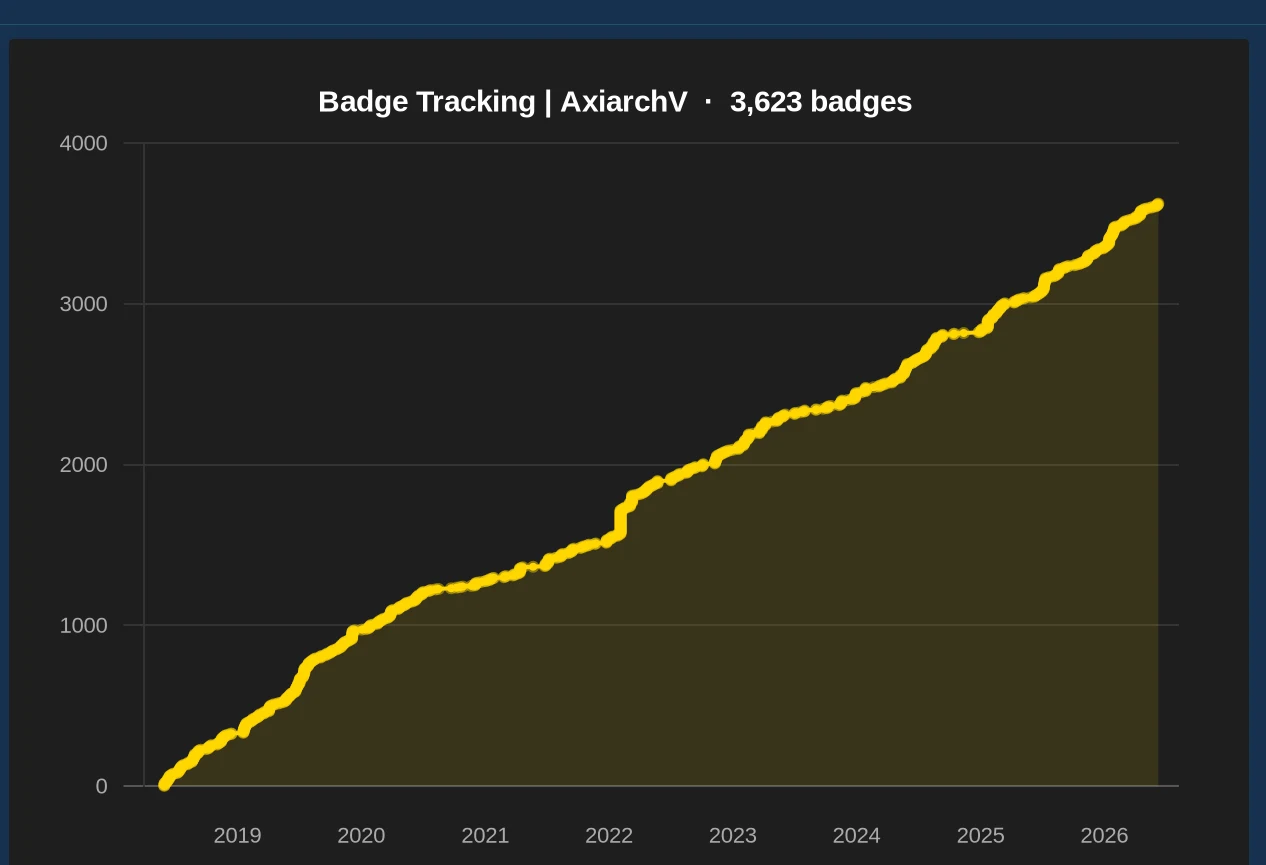
This is a real badge acquisition graph from a full report: 3,623 badges earned steadily across eight years. A farmed account looks nothing like this - its line jumps from zero to hundreds in a single day.
FAQ
What does a Roblox badge checker show you?
The instant check, with no account, shows the badge count (counted up to 100, shown as 100+ past that) and the most recent badges, next to an estimated alt score, account age, past-username count and online status. The full report, free on a quick sign-up, lays the badges out in full: every badge, the date each one was earned, and the full earning timeline. From that it flags badge spikes, where a large number of badges all land on a single day, which is a common sign of a farmed or freshly set-up account.
Do Roblox badges prove how old an account is?
No. Badges are a strong supporting signal, not proof. A long-term account usually earns badges slowly across many games and many dates, while a fresh or fake account has almost none or a wall earned in one day. Read badges next to the join date and name history rather than on their own.
What is a Roblox badge spike?
A badge spike is a cluster of badges all earned on the same day or within a few hours. A genuine player picks up badges gradually over months, so a sudden burst usually means the badges were farmed quickly to make an account look more experienced than it is.
Is the BGC Panel badge checker free, and does it need a login?
Yes, it is free. The instant check needs no account at all and shows the badge count, the latest badges, an alt score, account age, past-username count and online status. The full badge view, with every badge, the timeline and the spikes, is free too once you create an account, and it reads the same public badge data anyone can see on a profile, so there is never a password or private access involved on the account you are looking up.
Related guides
How to Check Roblox Badges
Where badges live on a profile, how to read the earning dates, and what a healthy badge history looks like.
Alt checkerRoblox Alt Checker
Estimate the odds an account is an alt by reading badges, age and name history together in one pass.
Alt detectionHow to Tell if a Roblox Account Is an Alt
The signals that separate a throwaway from a real account, and how badges fit into that read.
BGC Panel is not affiliated with, endorsed by, or sponsored by Roblox Corporation.