Spend any time trading, running a group, or moderating a Roblox community and the word "alt" comes up fast. Someone warns you about an alt, accuses another player of using one, or asks whether yours is allowed. It is one of those terms everyone throws around and few people stop to define. So here is the plain version.
A Roblox alt account is a secondary account run by someone who already has a main. That is the whole roblox alt meaning in one line. This post explains what an alt actually is, the many reasons people make them from completely harmless to clearly shady, and how an alt tends to look different from a main. It does not walk through a full detection method. For that, the dedicated guide on how to tell if a Roblox account is an alt goes deep on the signals and how to weigh them.
The definition: what "alt" actually means
"Alt" is short for "alternate." A Roblox alt account is simply an extra account that the same person controls alongside their primary one. There is nothing special about it under the hood. It registers the same way, has its own username, its own inventory, and its own join date. What turns an ordinary account into an alt is context, not code: it is an alt because the person behind it already has another account they treat as their main.
So when someone asks what is a Roblox alt, the honest answer is that an alt account on Roblox is just a second profile for one player. The label says nothing about intent on its own. A creator's test account and a banned scammer's fresh start are both technically alts. The difference is entirely in why it exists and how it is used.
Why people make alt accounts
Reasons for spinning up an alt account on Roblox sit on a wide spectrum. Plenty are completely innocent. Others are exactly why people get nervous when they spot one. It helps to see both ends side by side.
On the harmless side, an alt is often just convenience or privacy:
- A private second account. Somewhere to play away from a friends list, a public reputation, or a well-known main.
- Testing and development. Game creators use a clean account to see exactly what a brand new player experiences, with no items or progress to skew it.
- Content creation. Streamers and video makers keep a separate account for demos, fresh-start challenges, or filming without exposing their main.
On the shady side, an alt is a way to act without consequences landing on the real account:
- Ban evasion. Someone caught breaking rules makes a new account to slip back into a game or community.
- Scamming under a fresh identity. A clean main stays spotless while a disposable alt does the risky work, which is why it pays to check a Roblox trader before you trade.
- Fake giveaway shills and manipulation. Throwaway accounts get used to fake giveaway hype, pad vote or report counts, and make a scam look more popular or trusted than it is.
The takeaway is that not every alt is bad, but the bad uses all share a pattern: a fresh, low-stakes account doing something that would be risky on a real one.
How an alt differs from a main account
Because an alt is usually newer and less lived-in than a main, it tends to leave a thinner trail across a profile. None of these are proof on their own, but as a quick mental picture, an alt often shows up like this:
- A much younger join date. Most alts are recent, because the point of a throwaway is that it is disposable. You can read the creation date in seconds, as our guide to checking a Roblox account's age explains.
- Few or no badges. A real account collects badges slowly across many games and dates. A fresh alt has almost none, or a suspicious cluster earned all at once.
- A thin friends list and bare inventory. Time leaves a trail of friends, items, and group memberships. Alts are often nearly empty, or have a deliberately hidden inventory.
- Little or no name history. A long-term main may have changed names once or twice. A profile presenting itself as new but carrying a string of old names tells a story that does not line up.
A main account, by contrast, usually carries years of small traces: scattered badges, a real friends list, joined groups, and a generally lived-in feel. The mismatch between how an account behaves and how little history it has is the heart of what people are reacting to when they call something an alt.
Why it matters when you are trusting someone
If alts are technically just second accounts, why does anyone care? The answer is risk. Whenever you are about to trust a stranger, an alt changes the math, because a fresh account has nothing to lose.
Think about the moments where it actually counts:
- Trading. Handing a limited to a month-old account with no history is far riskier than trading with an established main that would hurt to lose.
- Recruiting. Bringing someone into a clan or staff team on an alt means you may be trusting a banned or burned player wearing a clean face.
- Giveaways and deals. A pile of brand new accounts cheering on an offer is a classic shill setup, not genuine social proof.
A long-standing main is not automatically safe, and a new account is not automatically a threat. But knowing whether you are likely dealing with an alt tells you how much caution the situation deserves before anything of value changes hands.
How to estimate the odds quickly
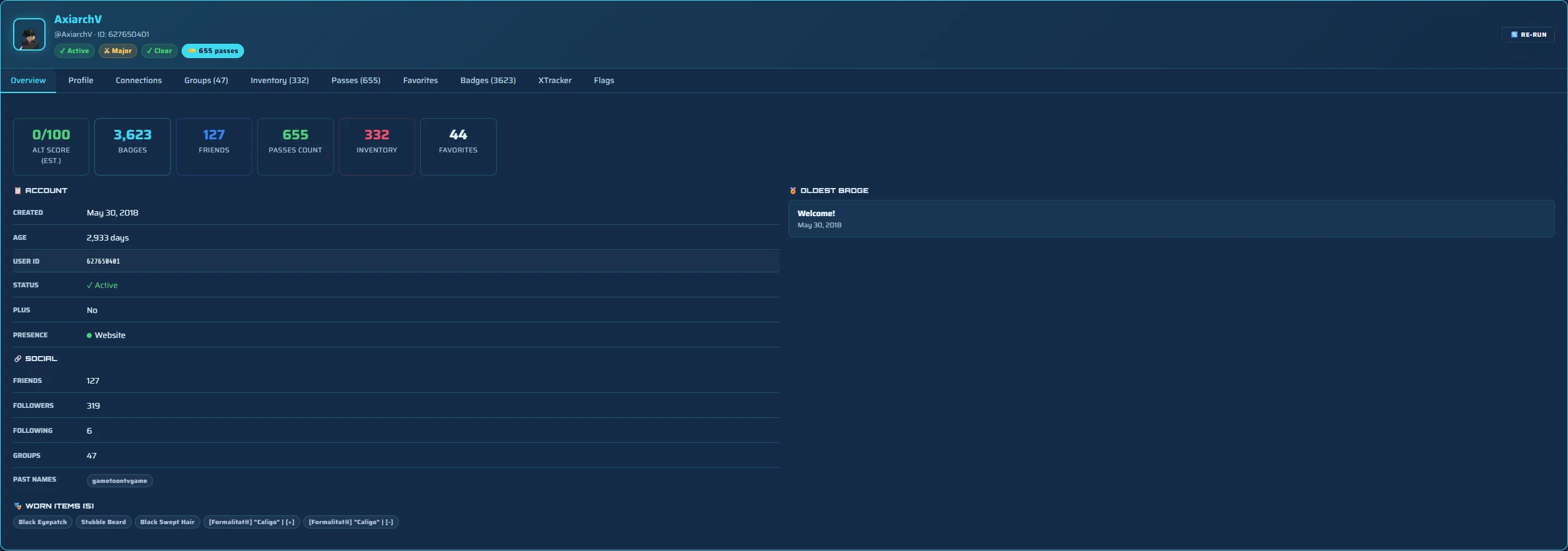
You will not get a yes-or-no answer on whether an account is an alt, but you can get a solid estimate, and you can get it fast. Every signal above comes from public Roblox data, which means it can be pulled and weighed in one pass instead of clicking through five tabs. The result is an estimate, not proof: how the alt score works explains the signals behind it.
That is what a free Roblox background check is for. The instant check on our free Roblox alt checker is a no-account preview: enter a username and you get an estimated alt score, the account age and creation date, the count of past usernames, and online status, so you get a quick first read in seconds. Sign up free to open the full report, which adds the real past usernames, the full badge timeline with spikes flagged, the inventory and groups, and the complete alt-score breakdown. You can run a free check on any public account to start. For the full method behind those signals, the alt detection guide breaks down each one and how to combine them without fooling yourself.
FAQ
What is a Roblox alt account?
An alt account is a secondary, or alternate, Roblox account that belongs to someone who already has a main one. The word alt is just short for alternate. It is a normal account in every technical sense. What makes it an alt is that the same person runs it alongside another profile.
Are alt accounts against the Roblox rules?
Owning a second account is not banned on its own. What gets people in trouble is what the alt is used for. Using one to evade a ban, scam, or break a game rule is against the rules, while a harmless private second account is fine.
How can you tell a Roblox alt from a main account?
An alt usually has a much younger join date, few or no badges, a thin friends list, a bare or hidden inventory, and little name history. No single signal is proof, so you read them together to estimate the odds.
Why does it matter if someone is using an alt?
It matters when you are about to trust them with something, like a trade, a clan role, or a giveaway. An alt has no reputation to lose, so it carries more risk than a long-standing main if things go wrong.
Related guides
How to Tell if a Roblox Account Is an Alt
Read age alongside badges, name history and activity to estimate the odds an account is a throwaway.
Account ageHow to Check How Old a Roblox Account Is
Where the Join Date lives, how to turn it into an age, and what counts as a suspiciously young account.
Tool comparisonBest Free Roblox Account Checkers (2026)
An honest side-by-side of the free Roblox profile checkers, from alt scoring to player tracking.
BGC Panel is not affiliated with, endorsed by, or sponsored by Roblox Corporation.